
Last updated October 15, 2026
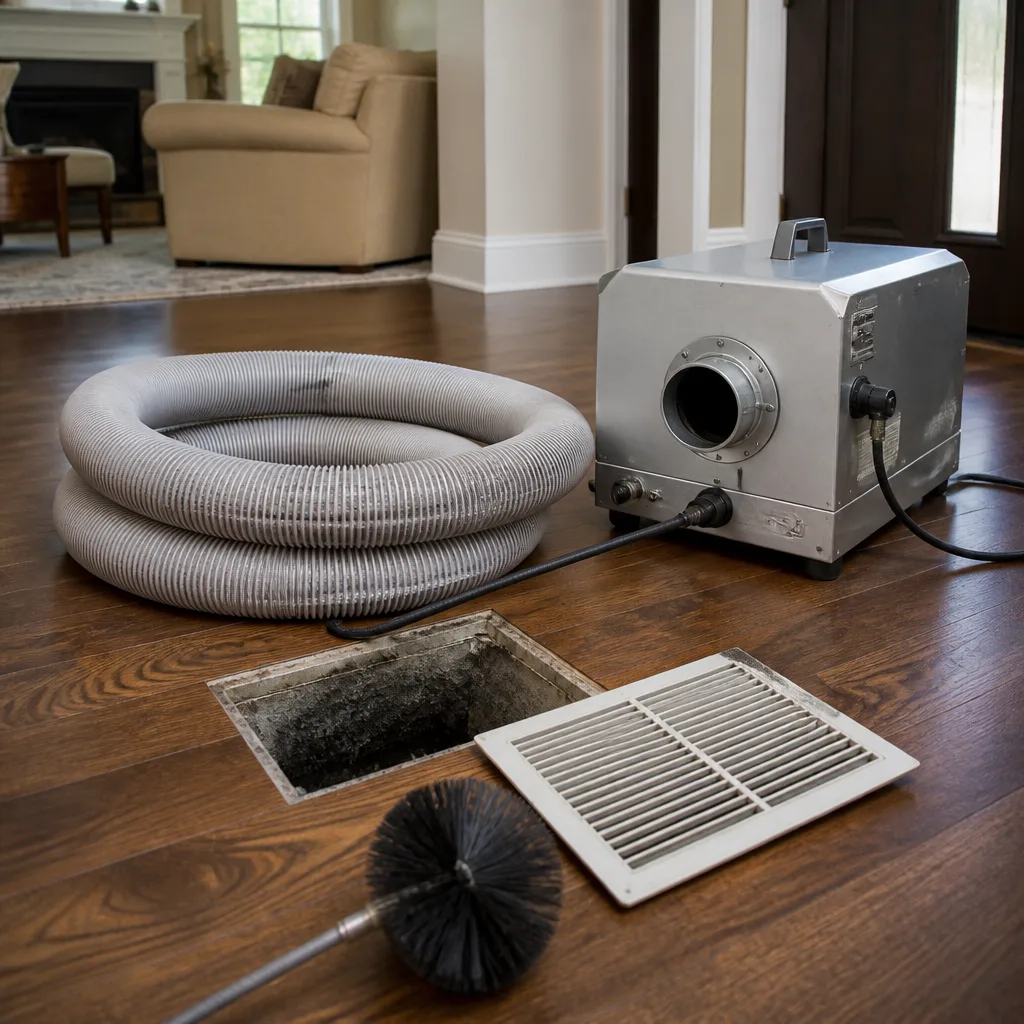 Whole-home duct cleaning
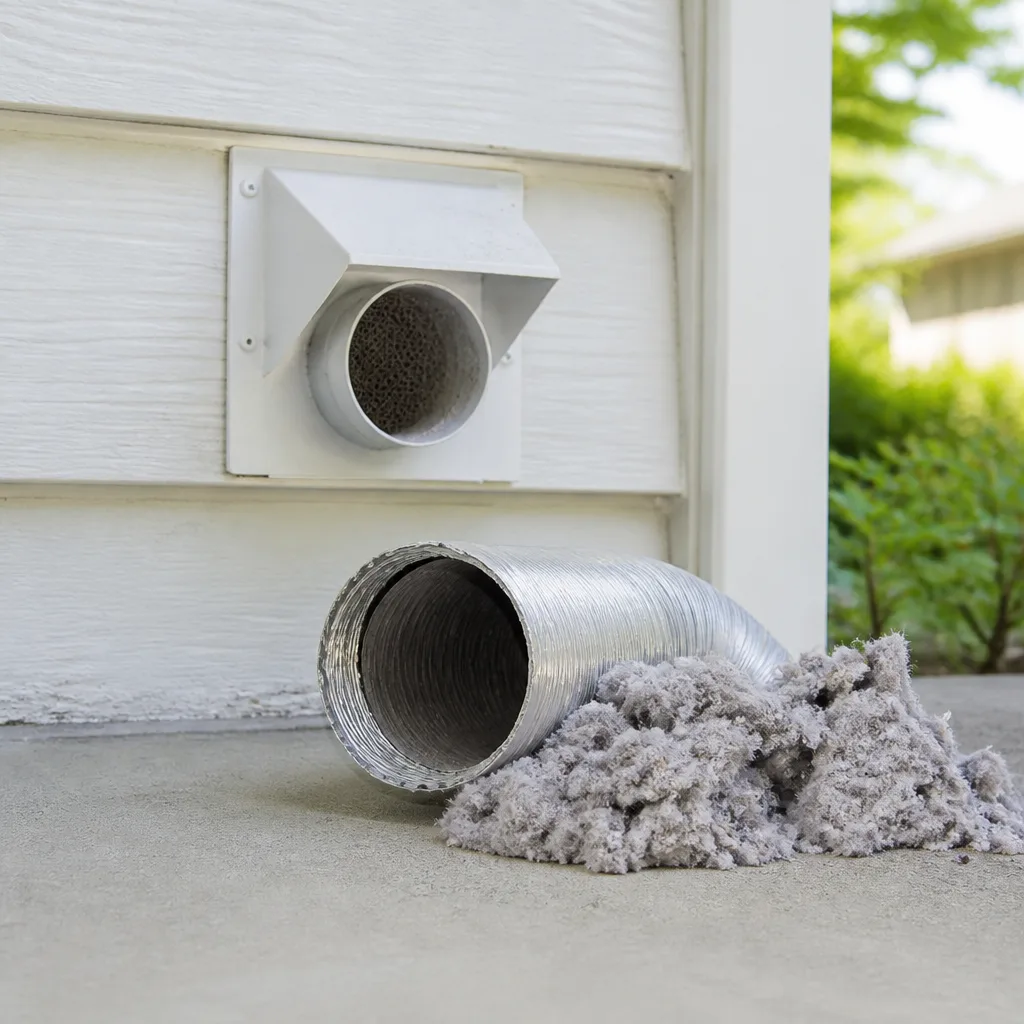 Dryer vent cleaning
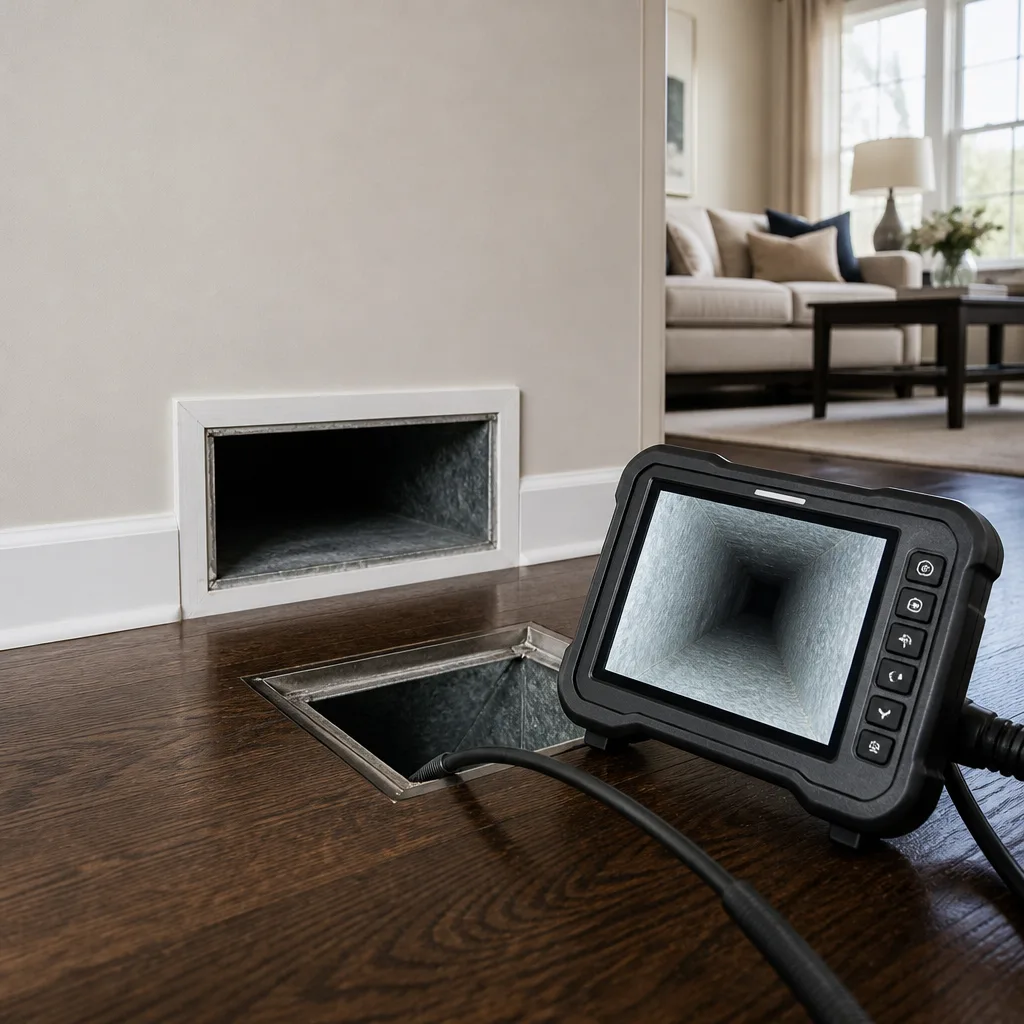 Camera inspection
 Sanitizing & deodorizing
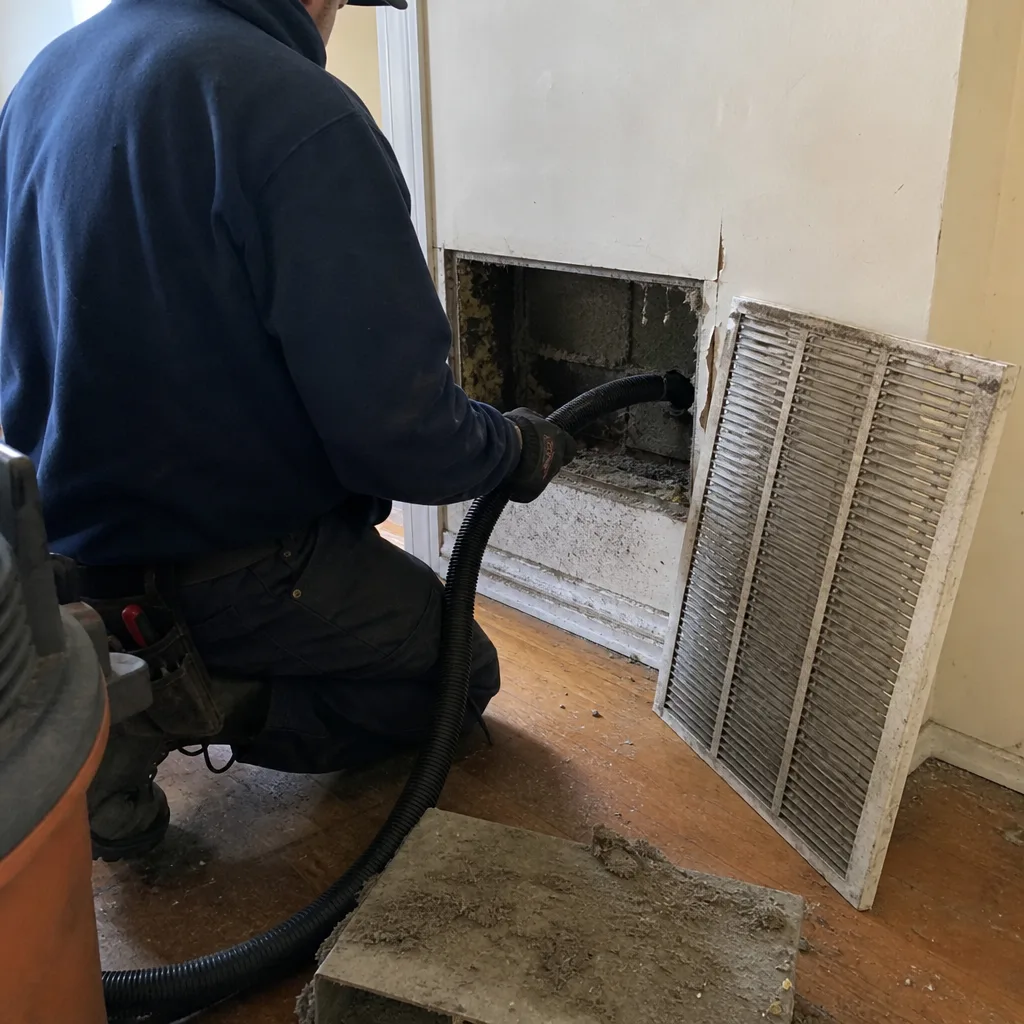
Whole-system duct and dryer vent check with before-and-after photos - you see exactly what came out of your vents
That "$99 whole-house special" is a bait ad - the real number appears once they are in your hallway, or the "clean" is a shop-vac at the register. We photograph the inside of your ducts before and after instead.
Air Duct Cleaning Permits, Codes & Inspections in NY: What You Need to Know
Here’s a scenario that plays out in Queens more often than most homeowners expect. A duct cleaning crew finishes the job, and the technician mentions that part of the duct in the crawlspace has rusted through. That repair, they say, will require cutting out a section and replacing it. What sounded like a routine service call now raises questions about permits, licensed contractors, and who’s responsible if something goes wrong. This guide unpacks exactly where the permit line falls in New York, why the duct cleaning itself rarely requires one, and how repair work can quietly pull you into NYC Building Code territory. For a deeper look at when cleaning turns into something more serious, see our Air Duct Cleaning Warning Signs: A Queens Homeowner’s Reference Guide. We’ll walk through what co-op and condo owners face, when mold remediation has its own licensing rules, and what documentation protects you.
Styles & brands we work with
Quick Answer
Routine air duct cleaning in New York does not require a permit, a special license, or a city inspection. However, if the technician discovers damage that requires duct repair, modification, or replacement, NYC Building Code may require a licensed HVAC contractor and – depending on scope – a DOB work permit. Mold found in ducts triggers separate New York State mold remediation licensing requirements that a duct cleaner cannot legally handle without the specific license.
Table of Contents
- The Key Distinction: Cleaning vs. Repair vs. Modification
- NYC Building Code and Duct Work: What Actually Triggers a Permit
- Mold in Ducts: NY State Licensing Rules Most Homeowners Never Hear About
- Co-ops and Condos: What Your Board Needs in Writing
- Unlicensed Contractor Damage: Your Documentation Trail
- Local Law 97 and Why HVAC Documentation Matters More Than It Used To
- How a Proper Duct Cleaning Works (And Why It Never Needs a Permit)
- Common Mistakes to Avoid
- When to Call a Professional
- Frequently Asked Questions
- The Bottom Line
The Key Distinction: Cleaning vs. Repair vs. Modification
The single most important thing to understand about our Air Duct Cleaning services in New York is that the law draws a hard line between cleaning and everything else. Cleaning is exactly what it sounds like: removing accumulated dust, debris, pet dander, and other contaminants from the interior surfaces of your ductwork. It involves negative-pressure extraction equipment, rotating brushes, and sometimes air washing tools. Nothing is being cut, removed, replaced, or structurally altered. No permit. No inspection. No special contractor license in New York City.
Repair is a different animal. When a section of duct has rusted through, separated at a joint, or been crushed, fixing it means either patching or replacing a component. Under the NYC Administrative Code and the NYC Building Code, mechanical work of this type falls under the jurisdiction of the Department of Buildings (DOB). In most cases, you need a licensed master HVAC contractor or a licensed plumber (plumbing licenses cover some duct-adjacent work in NYC, though HVAC contractors handle most duct repairs) to do the work, and depending on the scope, a DOB permit may be required.
Modification is the category most likely to surprise homeowners. Adding a new duct run, moving a vent, upsizing a return, or reconfiguring ductwork to accommodate a renovation all count as alterations. These almost always require a permit, and for good reason: duct design affects air balance, combustion safety for gas appliances, and moisture control. A poorly executed modification can backdraft a furnace or pull humid air into wall cavities. In Queens, where housing stock ranges from 1920s attached brick homes to postwar co-op towers, the condition and layout of existing ductwork varies wildly. For a full overview of what’s involved, read The Complete Guide to Air Duct Cleaning in Queens. We’ve cleaned ducts in Jackson Heights where the original galvanized runs from the 1930s were still in service, and we’ve seen converted Astoria warehouses where ductwork was improvised during a 2004 loft conversion. The age and originality of the ducts matters when a technician says “repair” or “replace.”
What Queens Homeowners Should Ask
- Is this cleaning only? If yes, no permit needed. Get it in writing.
- Does the repair require cutting into walls, floors, or ceilings? If yes, ask about DOB permits.
- Is any section of duct being added or moved? If yes, that’s a modification, not a repair.
- Who is the licensed contractor of record for the repair?
- Will there be a final inspection, and who schedules it?
NYC Building Code and Duct Work: What Actually Triggers a Permit
The NYC Building Code is specific about mechanical work, but the language isn’t written for a homeowner trying to figure out whether their air duct cleaning is legal. Here’s the plain-English version. Chapter 28 of the NYC Building Code (which adopts the International Mechanical Code with local amendments) requires permits for mechanical system work that involves installation, alteration, or removal of equipment. A permit is not required for routine maintenance, and that’s the key phrase: routine maintenance.
Routine air duct cleaning falls squarely into the maintenance category. The DOB itself does not list air duct cleaning among permit-required work. There is no air duct cleaning license in New York City, no city-issued credential specific to the trade, and no inspection protocol for duct cleaning work. In New York State, there is also no statewide duct cleaning license. A company performing duct cleaning in Queens needs to be a legitimate registered business – that’s it.
Where it gets murky is when cleaning reveals damage. If a technician says, “we should also replace that 6-foot run of return duct because it’s collapsed,” that replacement is mechanical alteration. The DOB requires a licensed contractor to file for a permit when the work exceeds the listed exemptions for minor work. The exemptions are narrow: things like replacing a thermostat, swapping a diffuser, or cleaning a condensate line. Replacing ductwork is not on the exempt list.
We’ve seen Queens homeowners get stuck in exactly this position. A homeowner in Bayside called us after another company’s technician claimed the ducts “needed to be completely redone” during what was scheduled as a $300 cleaning. The quote for “replacement” came to $7,400, and no mention of permits, licenses, or DOB filings was ever made. That homeowner was not dealing with an HVAC contractor; they were dealing with a cleaning crew that saw an upsell opportunity. Any company performing repairs on your duct system in NYC must be a licensed contractor, period. If they’re not, the work is illegal even if it’s done well.
Mold in Ducts: NY State Licensing Rules Most Homeowners Never Hear About
This is where the regulatory picture changes completely. Routine duct cleaning is unregulated, but mold remediation in New York State is a licensed profession. Under Article 32 of the New York State Labor Law, any contractor performing mold assessment or mold remediation work on a property larger than a single-family owner-occupied home must hold a mold remediation license issued by the NYS Department of Labor.
Here’s the nuance that matters in Queens. Queens has a huge number of two-family and three-family homes, plus co-ops and condos that are classified as multiple dwellings. For those properties, mold remediation in ductwork cannot legally be performed by a duct cleaning company unless that company also holds a NYS mold remediation license. The person doing the work must be trained and certified under EPA guidelines, and the company must carry specific insurance for mold work.
If mold is found during a duct cleaning, the correct sequence is:
- The technician documents the finding with photos and notes the location and approximate extent.
- The homeowner receives a written report that says “possible mold growth,” not a definitive “mold” diagnosis – only a licensed mold assessor can make the official determination.
- If the property requires it, a licensed mold assessor evaluates and writes a remediation plan.
- A licensed mold remediation contractor performs the work.
- A post-remediation clearance inspection is completed by a licensed third party.
We’ve seen this process unfold in Kew Gardens and Forest Hills co-ops, where a single humid summer can produce mold growth in shared duct risers. Co-op boards in those buildings are increasingly insistent on seeing the remediation license before they’ll approve any work, and for good reason: boards that approve unlicensed mold work expose the entire building to liability.
One honest note from our side of the business: if a duct cleaner says they can “kill the mold” with a spray treatment during a routine cleaning, ask to see their NYS mold remediation license. If they don’t have one, they’re offering to do work they’re not legally allowed to do in most Queens multi-unit buildings.
Co-ops and Condos: What Your Board Needs in Writing
Queens has one of the highest concentrations of co-op and condo units in the city, particularly in neighborhoods like Forest Hills, Rego Park, Kew Gardens, and Long Island City. If you live in a co-op or condo, your ductwork may be partially or entirely a building system, not a personal system. This distinction changes everything about what you need in writing.
In most Queens co-ops, the duct risers that run vertically through the building are common elements owned by the corporation. The horizontal runs that serve your unit specifically may be yours to maintain, or they may not be. Your proprietary lease or bylaws spell this out, but most shareholders have never read that section. Here’s what we’ve learned from working in these buildings since 2004: the board or property manager almost always wants to know about any duct work being done in the building, even if it’s just cleaning.
Before scheduling a duct cleaning in a co-op or condo, ask your board or managing agent these questions:
- Does the building require a certificate of insurance (COI) from the duct cleaning company before work begins? (Most do. The standard requirement is $2 million in general liability naming the building as additional insured.)
- Are there specific hours during which work can be performed?
- Does the building require a designated supervisor on site during the work?
- Is there a fire watch requirement if any burning or cutting will be done? (For cleaning, no. For repair, possibly.)
- Does the building require written confirmation that no shared risers will be affected?
After the work is done, provide your board or property manager with a written confirmation of what was performed. A good service report includes the date, the equipment used, the areas cleaned, the technician’s name, and before-and-after photos. We provide this as standard on every job, and it’s one of the reasons Queens co-op boards frequently approve our work without pushback. For more guides & resources on navigating building requirements, visit our blog. Boards want documentation. If your duct cleaner can’t provide it, you’re going to have a hard time with the building.
Unlicensed Contractor Damage: Your Documentation Trail
Let’s say the worst happens. You hire a duct repair contractor who is not licensed in NYC, and the repair fails. A separated duct floods your ceiling with condensation. The work was not permitted. Your insurance company asks for documentation, and you have none. What now?
The documentation trail matters more than the dollar amount of the damage. Here’s what protects you if you ever have to file a claim, sue a contractor, or defend yourself in a dispute with a co-op board:
- A written scope of work before anything starts. Not a text message, not a verbal agreement. A document that says what will be done, where, with what materials, and for what price. At Linden Air Duct Queens, every job gets a written price before any work begins. This is not a courtesy; it’s a legal document that protects both parties.
- Proof of the contractor’s license. If they claim to be licensed, ask for the license number and verify it on the NYC DOB website. If they can’t produce a number, they’re not licensed.
- Photos before, during, and after. Every repair should be photographed. Before-and-after photos of your own ductwork are also how you verify a cleaning was actually done, which we’ll get to later.
- A written warranty on the repair. Not a verbal promise. Every duct repair we do in Queens comes with a written guarantee and a free second visit if the repair fails. If a contractor won’t put it in writing, assume the guarantee is worthless.
- Insurance information. The contractor should provide a certificate of insurance showing general liability coverage. If they’re working in a co-op or condo, the building will almost certainly require it. If you’re in a private house, ask for it anyway.
One scenario we’ve seen repeatedly in Queens: a homeowner hires an unlicensed handyman to “redo” ductwork after a renovation. The work is shoddy. The homeowner’s insurance claim is denied because the insurer determines the damage was caused by unlicensed, unpermitted work. The co-op board (if there is one) levies a fine because building bylaws require licensed contractors. The homeowner is now out the cost of the bad repair, the cost of the damage, and the cost of doing it right the second time. The unlicensed contractor has vanished. This is not a rare outcome. It’s the default outcome when unlicensed duct repair goes wrong.
Local Law 97 and Why HVAC Documentation Matters More Than It Used To
Local Law 97, passed in 2019 as part of New York City’s Climate Mobilization Act, sets carbon emissions limits for buildings over 25,000 square feet. The first compliance period began in 2024 and the second arrives in 2030. Most single-family homes and small buildings are unaffected. But if you live in a large Queens co-op or condo building – think a high-rise in Long Island City or a large complex in The Rockaways – your building is likely covered.
Why does this matter for air duct cleaning? Because compliant buildings are increasingly strict about documenting mechanical system changes. If a duct repair or modification changes how ventilation works in the building, the building’s energy model may need to be updated. A building that exceeded its emissions cap and is facing penalties is going to be aggressive about tracing every mechanical system change.
In practical terms, this means co-op and condo boards in covered buildings now ask for more documentation than they did five years ago. They want to know what was done, whether the installed ductwork meets current energy code, and whether the work altered the building’s HVAC configuration. If you’re in a covered building, your duct repair contractor should be able to provide a summary of work that includes basic specifications: duct size, material, insulation, and airflow. A cleaning company that can’t provide a basic service report is not going to meet the board’s documentation requirements.
We’ve worked in several Queens buildings that fall under Local Law 97, and the pattern is consistent: boards want professional documentation, they want licensed contractors, and they want to see that the work was done to code. The days when a building would wave through a random duct repair are ending.
How a Proper Duct Cleaning Works (And Why It Never Needs a Permit)
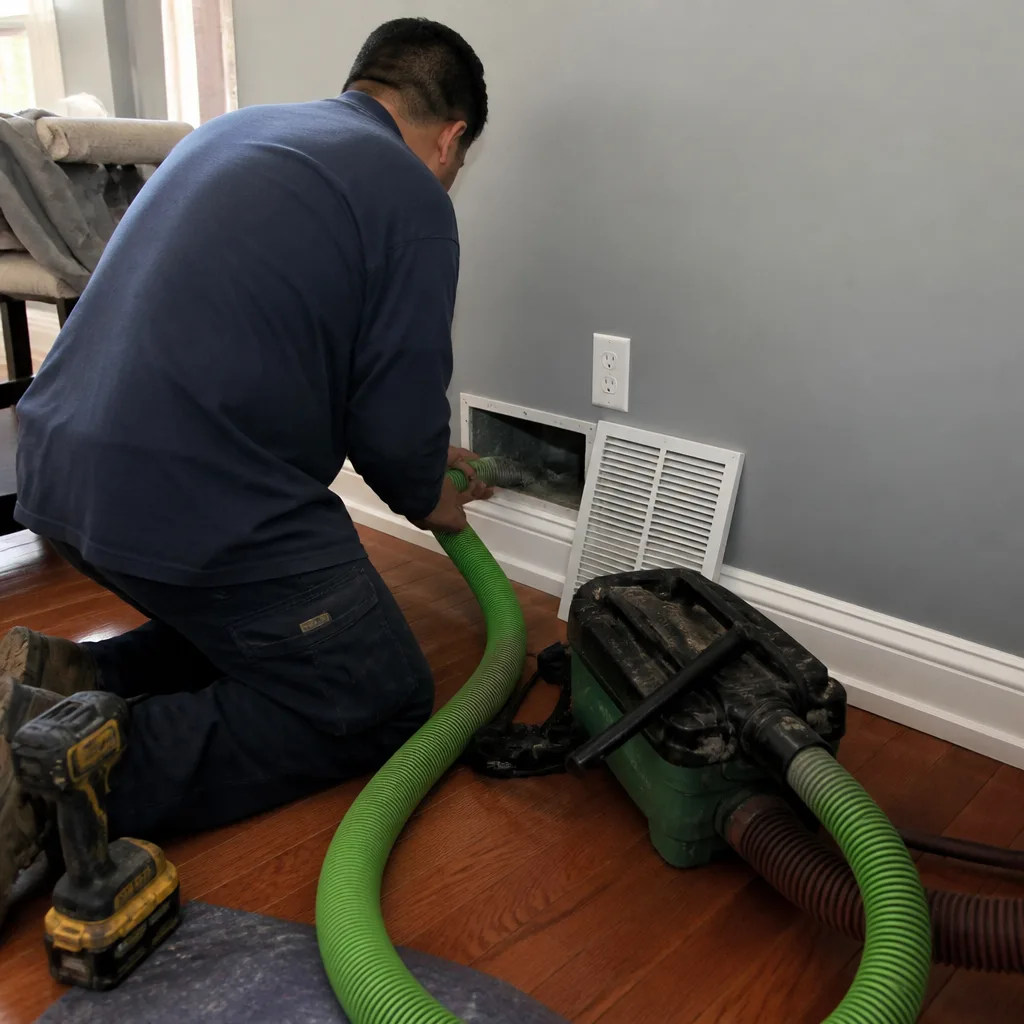
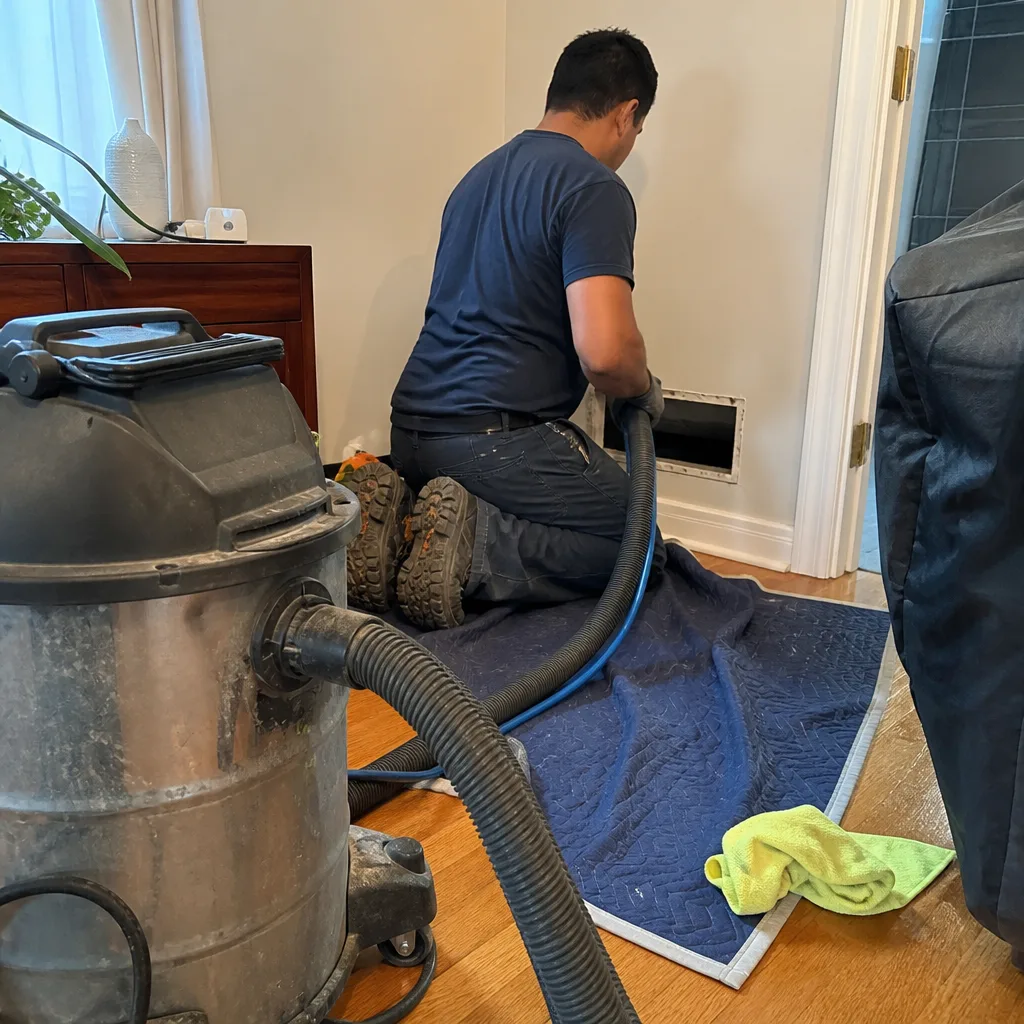
Understanding the cleaning process itself clarifies why the law treats it as maintenance. A professional duct cleaning uses negative-pressure extraction: a powerful vacuum is connected to the duct system, creating negative pressure that pulls loosened debris into a containment unit rather than blowing it back into your home. Rotating brushes or air whips agitate debris from duct walls, and the vacuum captures it. Air quality products from companies like Aprilaire can be integrated after the cleaning to maintain indoor air quality, but the cleaning itself is mechanical removal of particulate matter.
Nothing in this process changes the physical structure of the duct. No sections are removed. No new components are installed. The system is opened at existing access points, cleaned, and re-closed. This is the definition of routine maintenance, and it’s the reason no permit exists for duct cleaning in New York City.
What a proper cleaning does include:
- Inspection of accessible duct runs before cleaning begins
- Negative-pressure containment using commercial equipment from brands like Rotobrush
- Agitation of all accessible interior surfaces of supply and return ductwork
- Before-and-after photos of your ducts, not stock photos
- A service report documenting what was cleaned, when, and by whom
What a proper cleaning does not include:
- Cutting into walls, floors, or ceilings to access hidden duct runs
- Replacing or patching sections of ductwork
- Adding new vents, returns, or branch runs
- Applying mold-killing chemicals without a NYS mold remediation license
- Quoting a low per-vent price that balloons once the work begins
That last point deserves attention. The air duct cleaning industry has a documented problem with bait-and-switch pricing. A company advertises a $79 whole-house cleaning, the technician arrives, and suddenly the price is $1,400 because the job “requires more work than expected.” We don’t do this. Every job we do in Queens gets a written price before any work starts, and that price doesn’t change unless you ask us to do additional work you weren’t originally quoted for.
Common Mistakes to Avoid
- Accepting a per-vent price. Per-vent pricing is the classic bait-and-switch vehicle in this industry. A whole-system price, agreed in writing before work starts, is the only protection against the classic $79-cleaning-that-becomes-$1,400 trick. We quote one flat price per system, always.
- Letting an unlicensed company perform “repair” work. In Queens, duct repair requires licensed mechanical contractors. If the company doing your cleaning also offers to replace a duct section, ask for the license before anything gets cut.
- Skipping before-and-after photos. You cannot verify duct cleaning was actually done without visual evidence. A reputable company will show you photos of your own ducts, not stock images.
- Ignoring co-op board protocol. Queens co-op and condo shareholders who skip board approval for duct work often get hit with building fines or forced removal of the work. Get approval first, always.
- Treating mold as a cleaning issue. Mold in ducts is a remediation issue, not a cleaning issue. In multi-unit Queen buildings, mold work requires a NYS mold remediation license. A duct cleaner who offers to “spray for mold” without that license is offering to do work they can’t legally perform.
- Not keeping the service report. The written record of your duct cleaning is the document that proves maintenance happened if a warranty claim, insurance question, or co-op dispute arises. Keep it with your home records.
- Hiring based on the lowest price alone. The cheapest duct cleaning in Queens is usually the most expensive by the time it’s finished. One flat price per system, written before work starts, is worth more than any coupon.
When to Call a Professional
If you’ve never had your air ducts cleaned, or it’s been more than three to five years, the answer is now. If you notice visible dust blowing from your vents, if rooms in your Queens home are impossible to keep dust-free even days after cleaning, or if anyone in your household has unexplained allergy symptoms that improve when they’re away from home, a professional duct cleaning is the right call. If a technician finds rusted, separated, or crushed ductwork during the cleaning, stop and get a licensed HVAC contractor involved before any repair work proceeds. Linden Air Duct Queens offers free estimates across Queens, and our technicians are background-checked, identity-verified, and photo-badged. They arrive in a clean, marked uniform, and their name and photo arrive to you before the visit. Call (845) 237-0925 to schedule a free estimate. A live person answers the phone, any hour, every day.
Frequently Asked Questions
No. Routine air duct cleaning is classified as maintenance under the NYC Building Code and no permit, no special license, and no DOB inspection is required. It becomes permit-requiring only if the work includes duct repair, replacement, or modification.
No. New York State has no specific air duct cleaning license. That said, any repair or replacement work on duct systems must be performed by a licensed mechanical contractor in NYC, and mold remediation has its own NYS Department of Labor licensing requirement.
Air duct cleaning in Queens typically runs between $350 and $650 for a whole-home system, depending on the size of the home, the number of systems, and the condition of the ductwork. Repairs, if discovered, are priced separately and should be quoted in writing before any work begins. For an exact quote on your home, call (845) 237-0925 – estimates are free.
Low per-vent prices are almost always a hook to get a technician into your home, after which the price climbs with “recommended” add-ons. Reputable Queens companies quote one whole-system price in writing before any work starts, with no per-vent games and no surprise charges at the end. If a quote is dramatically below the market range for Queens, the gap usually disappears by invoice time.
Ask for before-and-after photos of your own ductwork, not stock images. Our technicians use specialized inspection cameras and provide photographic proof so you can see exactly what was in your ducts and what they look like after the cleaning. A written service report should accompany every job.
If mold is found during a duct cleaning, the technician should document it with photos and flag it for a licensed mold assessment. In most Queens co-ops, condos, and buildings over multiple dwelling classification, remediation must be performed by a NYS Department of Labor-licensed mold remediation contractor. The duct cleaner’s job is to notify you and stop; it’s not to spray it with bleach and keep going.
No. Duct repair and replacement in NYC must be performed by a licensed contractor. Homeowners who use unlicensed handymen for duct work risk insurance claim denials, co-op board penalties, and the cost of redoing the work properly when it fails.
No. There is no city inspection protocol for routine duct cleaning. DOB inspections come into play only when duct repair or modification requires a permit, in which case the permitted work is subject to inspection by a city inspector.
The Bottom Line
The New York regulatory picture for air duct work is deceptively simple: cleaning is maintenance and needs no permit; repair and modification are construction and need a licensed contractor with DOB oversight; mold remediation has its own state license. Most Queens homeowners only learn the difference when a simple cleaning turns into a repair recommendation mid-job. The practical lesson is documentation: written scope, written price, written warranty, photographic proof, and the license number of anyone doing repair work. Get those five things in writing, and you’re protected in ways most homeowners never are. For a free estimate in Queens, call Linden Air Duct Queens at (845) 237-0925. A live person answers, any hour, any day.
Written by Marcus Veale, Owner at Linden Air Duct Queens, serving Queens since 2004.
See the difference
 Before
 After
After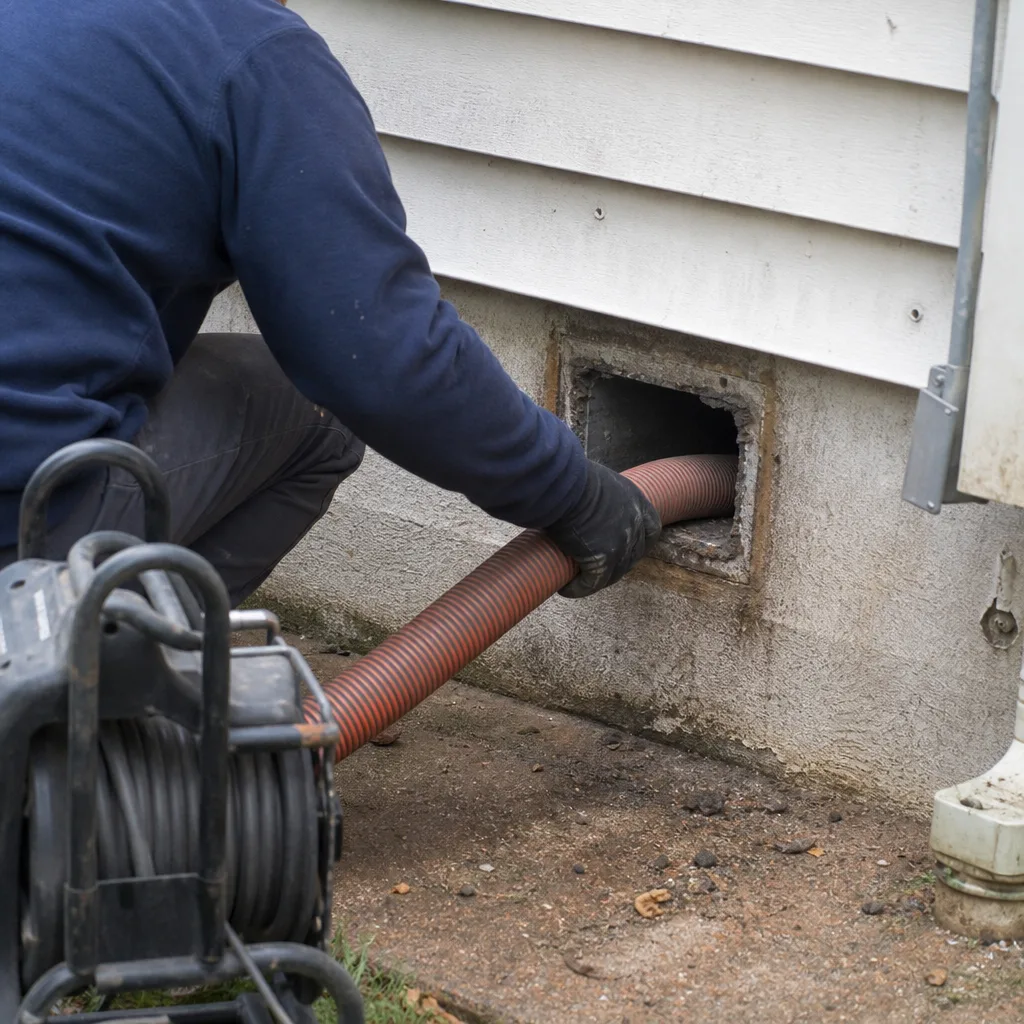 Before
 After
After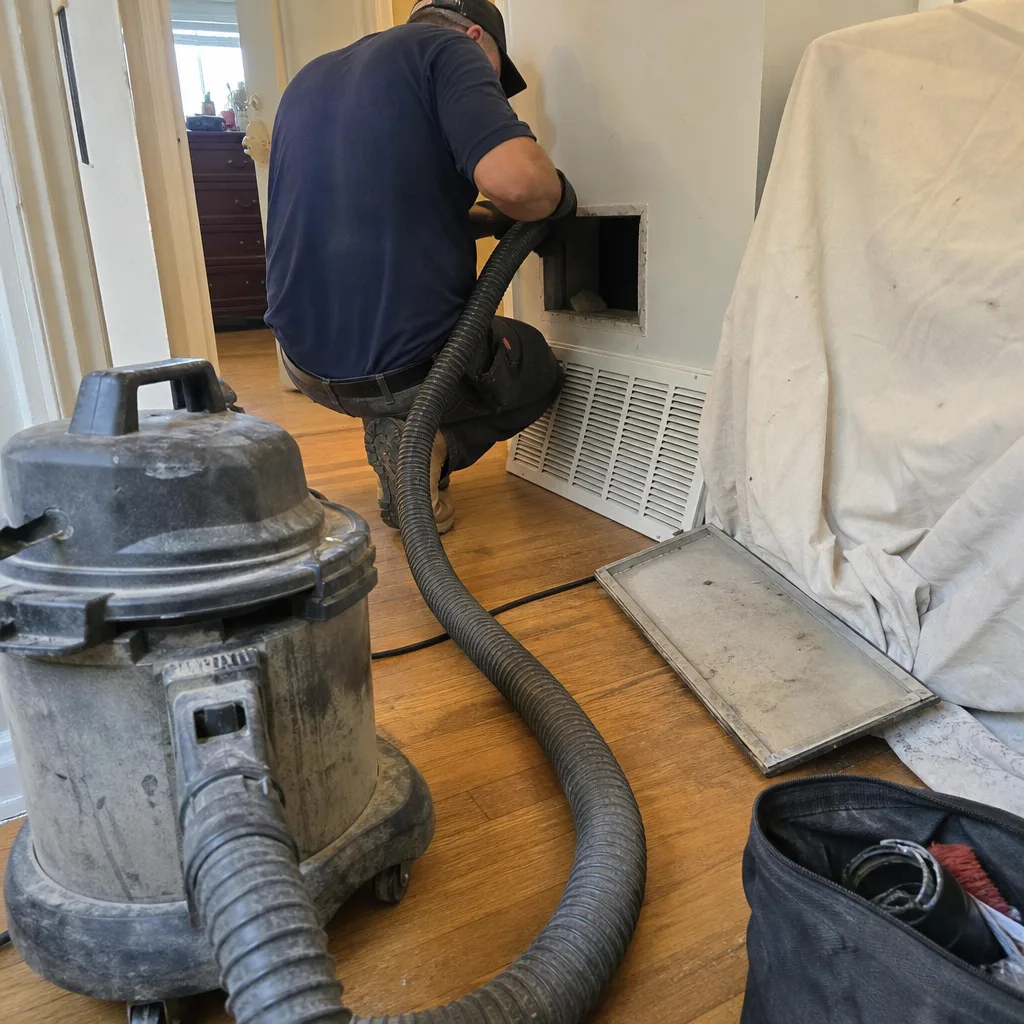 Before
 After
After